Insight, analysis & opinion from Joe Paduda

Dec
18

MedRisk and Carlyle

Focus, customer service, and execution are the three reasons MedRisk has thrived over the last several years.

That’s what Carlyle bought into when they invested in the company in a transaction that will be announced today. This comes less than two years after TA Associates bought a minority stake in the company, one of the quickest “flips” in the workers’ comp services industry.

Disclosure – MedRisk is an HSA consulting client.

I could not be happier for Founder and Chair Shelley Boyce, CEO Mike Ryan, EVP Marketing Rommy Blum, COO Michelle Buckman, CFO Tom Weir, and CIO Vic Pytleski – the rest of the professionals at MedRisk – and the customers MedRisk serves. Great people built this company by focusing relentlessly on execution, sticking to the business they now dominate, and doing business the right way.

And they will continue doing exactly that.

MedRisk continues to innovate, building the industry’s first telerehab program (which is up and running under Mary O’Donoghue’s leadership). A home-built IT platform specific to the industry is making adjuster’s days easier, communications smoother, and patient scheduling a matter of a few hours.

Management is staying. An oft-heard mantra in private equity is “you’re investing in the management team”, and nowhere is this more true than in this transaction. You will see the same people doing the same great work for years to come.

There is one major change; now that MedRisk is in the Carlyle portfolio, the company’s access to capital is greatly expanded. How and where that capital might be deployed is to be seen.

What is crystal clear is this: MedRisk will be a buyer, not a seller.



Dec
15

How’d I do on my 2017 workers’ comp predictions?

Every year I dance the danger line, coming up with predictions for the upcoming year. And every year I hold myself accountable, reporting to you, loyal reader, exactly how those predictions worked out.

Clearly not a self-portrait; I could never grow that facial hair…

So here’s this year’s results…

(predictions are here)

  1. Premiums will rise as employment and wages continue to grow.
    It’s a yesRates continue to decline, but hourly wages have been ticking up for over a year now, and employment has been trending up for over 60 months. So, the combination has overcome the drop in rates. For now…
  2. Medical costs will remain flat or close to it.
    Not according to NCCI – at least not for last year in NCCI states. Medical costs increased 5 percent last year. California is not an NCCI state; trend was up 6 points last year. So, got that one wrong.
  3. Frequency will continue to decline.
    Because it always does. On average, by 3.6 percent a year.
    That means there will be about 10 percent fewer claims in three years, 20% fewer in six.
  4. Insurers will double down on efforts to reduce administrative expenses.
    Frequency’s down, investment returns are dropping, and medical costs pretty much under control; premium rates are headed lower as well. So, insurers have continued their efforts to slash admin costs by outsourcing more claims to TPAs (contacts in the TPA business indicate that’s their biggest source of growth).
  5. More payers will move their claims adjusters to home offices.
    No news on this – so I’ll count this as a no.  If you know of moves, let me know.
  6. Winners will focus on execution.
    Yes
    . MedRisk [HSA consulting client] has taken the top spot in physical medicine management from competitor OneCall by out-executing OC. PBMs that deliver seamless customer service, lower drug costs and reduced opioid spend are winning; myMatrixx is perhaps the best example. Kaiser Permanente on the Job is another example; K-PoJ is delivering better results for patients and employers by doing what KP does so well – focusing on what patients need, not what creates billing opportunities. And BWC Ohio has made amazing progress in reducing unnecessary opioid use – by developing and implementing a comprehensive, careful approach.
  7. Telemedicine is coming fast
    Yes indeed.  Coventry, MedRisk (HSA consulting client), CHC Telehealth (Mitchell has helped fund CHC), Kura, and other entrants were all over the NWCDC. MedRisk’s telerehab program is up and running, and case management firms are moving quickly.
    Unlike other “innovations”, tele-services is going to change everything.
    8.  Mitchell will continue to add work comp services businesses via acquisition.
    Yes –
    Unimed and PMOA are additions this year, adding breadth to both the UR and PBM businesses. I’d expect more in the future – although there are fewer businesses to buy that fit well with the company’s strategy.
    9. Drug cost decreases will flatten out somewhat, while reductions in opioid spend will continue to increase.
    Well, I got this one partially – but pretty badly – wrong. Costs dropped by double digits, led by a 13.6 percent decline in opioids.  And I’m supposed to know a lot about this business…sheesh.
    10. More value-based payment pilots will hit work comp.
    That’s a really easy prediction, so I’ll quantify it – there will be more than five new pilots or program seeking to deliver care via bundled payments or similar mechanisms that will start in 2017.
    Well, except for K-PoJ I can’t find any evidence that this happened – and in fact in a post a few months after my 2017 predictions, I backtracked bigtime on this prediction. Any new news on this is welcomed.
    11. Bonus pick – more consolidation in case management
    As frequency and severity continue to slide, field case management businesses are going to have to find new revenues from new services they can offer to current clients/cases and get more revenue from current cases.
    Argh…haven’t seen much evidence of this – perhaps because there’s already been a lot of consolidation.

The net – I got 4.5 wrong out of 11.  Ouch.

I’m hoping to do a LOT better with next year’s prognostications.


Dec
14

It’s not a tax bill, it’s a healthcare bill

OK, a bit of hyperbole – but only a bit.

Here’s how the Trump Tax Bill will affect healthcare…

  1. Immediate $25 billion cut in Medicare spending followed by a total of $400 million over the next nine years
    This has to happen under “PAYGO” rules which require offsets in spending when revenues are cut (as will happen under the Trump Tax).  Medicare is NOT AN ENTITLEMENT, it is an EARNED benefit. Starting January 1, 2018, doctors, hospitals, and pharma are going to take the hit as Medicare will stop paying for some care delivered by doctors.
  2. 13 million (+/-) more people will lose health insurance
    If you can sign up AFTER you get sick, why would you pay premiums until you need insurance? The bill ends enforcement of the mandate, but insurers are still REQUIRED to take all comers. So, many younger and healthier people will not sign up, and when they don’t the “pool” of insured people will get older, less healthier, and therefore more expensive to insure.
  3. Individual health insurance premiums will go up about 10%
    So, Insurance companies will raise premiums by about 10% as healthcare costs for the older, less healthy population will go up.
  4. Drive insurers out of the individual and small group markets
    See above…
  5. Reduce drug development for “orphan” diseases
    Today pharma gets a major tax break for developing treatments for orphan diseases, such as cystic fibrosis, epilepsy, muscular dystrophy and Angelman syndrome. It appears that tax break goes away – and this will greatly reduce R&D. The tax credit has been cited as responsible for treatments for about 350 diseases; there are around 7000 in total.  Here’s one pretty amazing success story that will likely not be repeated due to the end of the tax credit.

With fewer people covered by insurance, and higher rates for those that are, we’re likely to see more insurers drop out of more markets.

The greatest impact will be seen several years down the road, when the overly-optimistic growth projections prove to be just that. Already, experts predict the Trump Tax Bill will add over a trillion dollars to our national debt. When that happens, there are going to be calls for massive cuts to ALL services – including Social Security, Medicare, and Medicaid.

What does this mean for you?

I’m thinking Medicaid for all by 2027.


Dec
12

What we missed while we were in Vegas

The world didn’t stop while we were meeting, learning, and socializing in Las Vegas at NWCDC. Here’s what happened…

Sedgwick is getting bigger – again. The acquisition of Cunningham Lindsey makes Sedgwick the largest TPA in the land, with about 20,000 employees handling various aspects of claims and related functions.

Pharmacy and related topics

California’s work comp formulary goes into effect in 3 weeks.  Make sure you’re ready by hearing from those who know it best – the folks at CWCI. Their webinar is available here (free to CWCI members, $50 for non-members)

An excellent primer on handling opioid treatment issues – specifically effective ways to end opioid treatment – comes from Coventry’s Nikki Wilson, PharmD via WorkCompWire.  It’s simple, clear, and concise.

Sticking with drugs, Adam Fein reminds us “In 2016, U.S. net spending on outpatient prescription drugs was $328.6 billion, up only 1.3% from the 2015 figure.” [emphasis added] In contrast, CompPharma’s latest Survey of Prescription Drug Management in Workers’ Comp shows a drop of 11 percent year over year. 

Employment

Employment is going to change – a lot – over the next decade. A thought-provoking report by McKinsey includes this prediction:

One result – “the share of the workforce that may need to learn new skills and find work in new occupations is much higher: up to one-third of the 2030 workforce in the United States” – with major implications for worker retraining, potential claiming behavior, and re-employment. 

A reminder about the unseen consequences of the gig economy: airport revenues are dropping as passengers increasingly use ride-sharing services instead of paying for parking, renting cars or using cabs. I’ve reduced my use of rental cars; even if Lyft is occasionally more expensive, the hassle reduction factor plus the ability to work in the car to and from the airport are compelling.

A total of $5.8 billion was collected by airports from cab companies, parking, and rental car fees, more than they get from hotels, shops and restaurants combined.

Auto mechanic employment is also going to change – as more people switch to electric cars, there’s going to be a LOT fewer problems for mechanics to fix and even regular maintenance is limited to tires and wiper blades.  We have an electric BMW i3; it has needed zero maintenance other than tires.

Takeaway – the downstream effects of the “gig economy” are far reaching indeed.


Dec
11

Uncomfortable truths at NWCDC

Frank Pennachio is one of those people every industry really needs. He’s blunt, outspoken, deeply insightful and completely unafraid to challenge established practices.

Especially when those practices need to be challenged. Thursday at NWCDC, Frank and Denise Algire discussed the ways employers pay for managed care services, and how those are often disconnected entirely from the quality of the care delivered to patients.

Frank’s key question is this; do managed care programs improve care or create revenue for intermediaries?

My take is both. I’d also echo Frank’s view that employers and brokers are just as culpable, if not more so, than claims payers and managed care companies. Employers’ desire for simplistic fee arrangements and unwillingness or inability to dive deeper into fee arrangements force (or allow, depending on your perspective) TPAs to seek revenues elsewhere.

Transparency is what’s missing; contracts between and among TPAs and employers don’t allow employers to see the financial relationships between the TPA and managed care companies and providers and understand the motivations and incentives inherent in those relationships.


Fee arrangements are the key to the puzzle. TPAs charge employers a flat per claim fee or a loss conversion factor (losses x X.XX%) to cover the cost of handling claims, and that’s pretty much the only thing the employer looks at or cares about.  Thus, allocated loss adjustment expenses are rarely addressed. What employers should be paying attention to are undisclosed side agreements and Allocated Loss Adjustment Expense bucket, where those fees end up charged to the file.

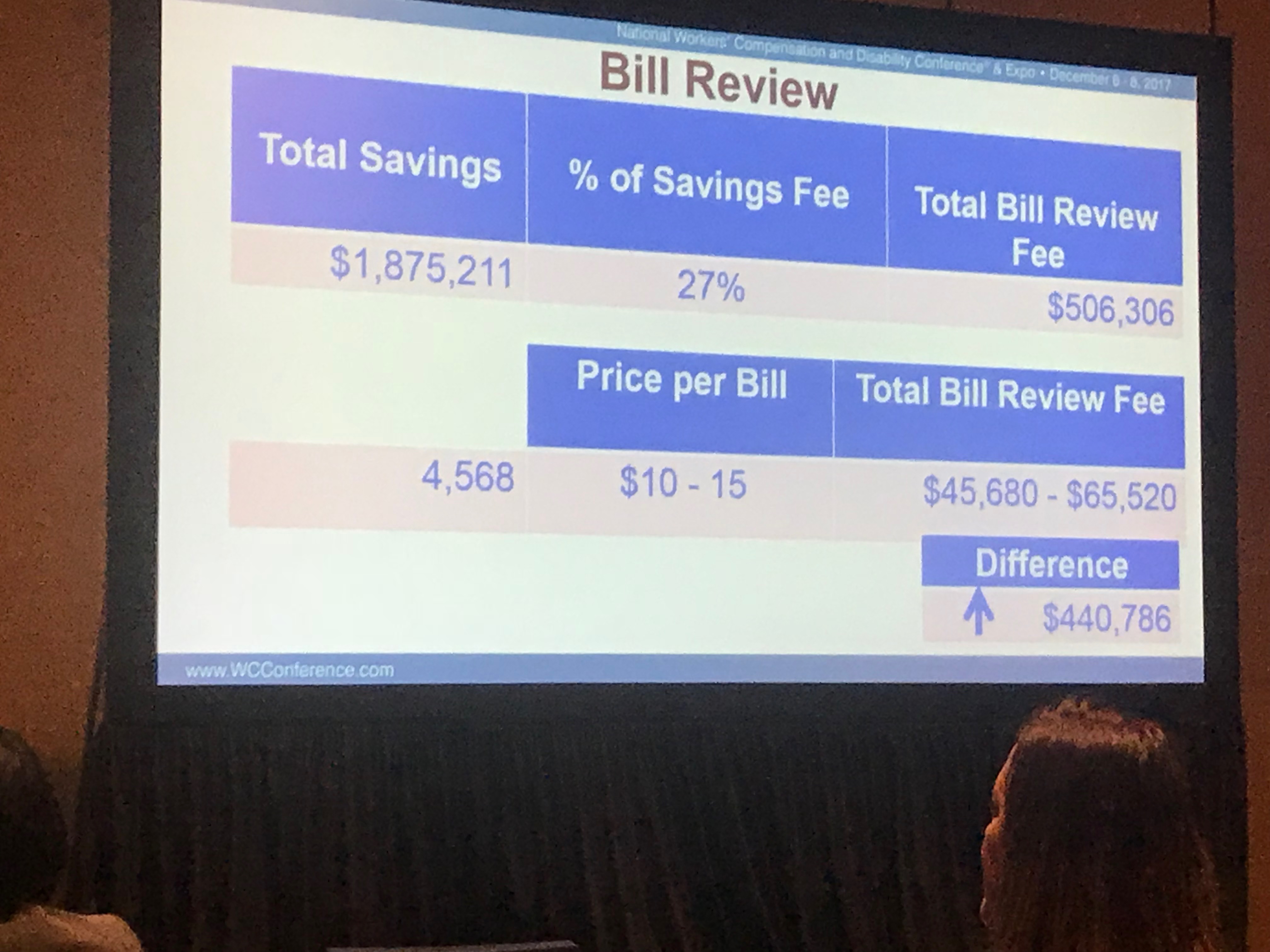
Frank showed a report from an employer that identified bill review fees of over $500,000 for some 4600 bills.  Of course, this was based on a fee structure using a percentage of savings below billed charges – an arrangement that like vampires just won’t die.  Frank noted that many bill review companies are quite willing to charge a flat per-bill fee that includes networks, medical management, and other “savings”. (I have a somewhat different perspective and believe the price per bill should be considerably higher, but fundamentally agree with Frank)Part of me is stunned that we are still talking about this. This has been a subject of conversation many times over many years, and yet, here we are. And here we’ll stay until and unless employers demand something different – and


Albertson’s is one of the few large employers challenging this paradigm. Denise shared Albertsons’ network contracting strategy, and of particular interest were the outcomes measures they use. Albertson’s is quite willing to pay for better outcomes, and is diligent in tying outcomes to providers.


So what can you do?

  1. Require full disclosure of all fees and side arrangements among and between your TPA and other parties.
  2. Require reporting of all funds transfers
  3. Realize you are going to have to pay higher per claim fees and/or higher unallocated loss adjustment expenses.
  4. Require documentation and reporting on quality measures for all medical care including networks.
  5. Be willing to pay more for better outcomes.


Dec
7

The GOP bill “hits a snag”

This is a non-healthcare post.

The GOP tax bill is a mess, riddled with math errors, contradictory language, and un-implementable directives.

One  is a huge and possibly un-fixable problem for the GOP – unfixable without ignoring requirements to keep the deficit-increasing impact of the bill within strict limits..

Late Monday night, the news that drafters made a $289 billion mistake hit the wires, infuriating the very corporate bigwigs the bill was supposed to reward.

Without getting too far into the weeds, a last-minute addition to the bill in the Senate added the Corporate Minimum Tax back to the bill, which effectively killed a bunch of other incredibly popular tax breaks – like the Research and Development credit. That will raise costs by perhaps $289 billion.

Here’s what one totally pissed off Republican CEO said:

Robert Murray,C.E.O. of Murray Energy Corp., angrily estimated that his company’s tax bill would increase by $60 million. “What the Senate did, in their befuddled mess, is drove me out of business and then bragged about the fact that they got some tax reform passed,” Mr. Murray said in an interview. “This is not job creation. This is not stimulating income. This is driving a whole sector of our community into nonexistence.”

But both the House and Senate have passed the bill, you say, so they’ll figure it out in the Conference Committee.

Not so fast.

To “fix this”, conferees will have to find the same amount of revenue from other sources. So, other taxes are going to go up – a lot. Or the AMT for companies will have to disappear. And given the very tight timeline to get this done, and the intransigence of the “freedom caucus”, and the furor over many other provisions, the longer this thing is in the public’s eye, the less chance it has of becoming law.

And the less damage it does to health insurance companies, Medicare recipients, doctors and hospitals.

Which is a very good thing.

Folks, this stuff is complicated. We live in a very, very complex world, and there are NO simple solutions to the really knotty problems we have. It’s time to take a set aside the sound bites and get to governing.


Dec
6

Vegas day one

Got in yesterday, and the whirlwind started. Initial takes…

Thanks to the wonderful folks at myMatrixx for carting me and pretty much everyone else from the airport to our hotels.

The Mitchell last night event was very well attended; it was going strong well into the night.

Telemedicine is the next big thing – there are at least a half-dozen companies focusing on this, with many more touting their adoption of pieces and parts of telemedicine. Like anything else, there’s going to be a shakeout – more on this next week.
But make no mistake, unlike many flashes-in-the-work-comp-services pan, telemedicine (or whatever term you use) is going to be a big, big deal.

The CVS acquisition of Aetna will have zero effect on Coventry. Or maybe even less. The new company’s revenues are almost a quarter-trillion dollars; Coventry work comp’s annual take is less than a quarter of one percent of that.

A couple folks aren’t here this year. Bill Block is one. Bill passed away this year; universally liked, Bill was just a good guy, a relationship guy who knew everyone and had a good word for all. He’d been in the business for decades, working for several different companies, bringing his smile and good cheer wherever he went. Bill will be missed.

Funally, confession time. I have a horrible memory for names and faces. And most other important things. Please accept my heartfelt apologies!


Dec
5

Prepping for Vegas

Here’s a few pointers for those in or heading to the NWCDC confab in Vegas.

1.  Realize you can’t be everywhere and do everything. Prioritize.

2.  Leave time for last-minute meetings and the inevitable chance meetings with old friends and colleagues.

3.  Unless you have a photographic memory, use your smartphone to take voice notes from each meeting – right after you’re done.  Otherwise they’ll all run together and you’ll never remember what you committed to.

4.  Get the NWCDC app for your Droid or iPhone – there’s a web-based version too for tablets.  It has the schedule, exhibit hall layout, local map, and a bunch of other handy information and tools.

5.  Introduce yourself to a dozen people you’ve never met.  This business is all about relationships and networking, and no better place to do that than this conference.

6.  Wear comfortable shoes, get your exercise in, and be professional and polished.  It’s a long three days, and you’re always ‘on’.

Finally, I’ll echo one of Sandy Blunt’s points – in these day of YouTube, phone cameras, Twitter and Google+, what you do is public knowledge.  That slick dance move or intense conversation with a private equity exec just might re-appear – to your dismay.


Dec
4

Why the GOP tax bill increases health insurance premiums

I received several emails from readers challenging my statement Friday that the GOP tax bill will result in higher health insurance premiums.  Here’s how.

Briefly, the Bill lets you buy health insurance after you get sick – without a penalty. It’s as if this guy was signing up for auto insurance post-crash…

Both the House and Senate versions of the bills end the penalty for those who don’t have health insurance. This penalty does 2 things; it financially penalizes those who go without coverage, and it generates funds that help pay for healthcare for others.

What the tax bills DON’T do is change the requirement that insurance companies cover anyone who applies.

Imagine if you were able to buy auto insurance after you crashed. Why would you bother to sign up and pay those premiums if you didn’t have to?

BTW, there’s a ton of research and history that shows what a bad idea this is, how much damage it does to insurance markets, and what we can expect.

Folks, this is just ONE example of the dumb ideas in this bill, from people who claim to understand how the free market works.

What does this mean for you?

Insurance rates are going to go up. 


Joe Paduda is the principal of Health Strategy Associates

SUBSCRIBE BY EMAIL

SEARCH THIS SITE

A national consulting firm specializing in managed care for workers’ compensation, group health and auto, and health care cost containment. We serve insurers, employers and health care providers.


DISCLAIMER

© Joe Paduda 2026. We encourage links to any material on this page. Fair use excerpts of material written by Joe Paduda may be used with attribution to Joe Paduda, Managed Care Matters.

Note: Some material on this page may be excerpted from other sources. In such cases, copyright is retained by the respective authors of those sources.

ARCHIVES

Archives

error: Content is protected !!