Jan
1

Insight, analysis & opinion from Joe Paduda
Well, proving once again that I can’t/won’t learn from past mistakes, here are five of my predictions for 2020.




And possibly broken up by the buyer. After KKR and GSO’s takeover of the near-bankrupt company two months ago, not much has been heard from Jacksonville HQ. After the balance sheet clean-up and Polaris review are completed, expect the new owners to put it up for sale. KKR and GSO will turn a handsome and quick profit, prior debtholders won’t have to write off their entire portfolio.
No word on whether employees will get something back as well; that would require action by the current owners as “old” stock is essentially worthless.Next time – the next five.
Two Republican-appointed judges on a Federal appeals court struck down a key provision of the ACA. So what?
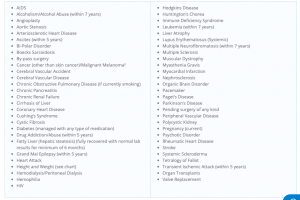
Well, if you or a family member are a bit heavy, have high blood pressure, are pre-diabetic, had a bout of cancer, may need long-term care, make less than $103,000, are pregnant, pay attention.
Another judge will decide if the entire ACA or parts of the very broad law are struck down. Among the provisions at risk are:
SOME of the pre-existing health conditions that would not be covered if the ACA goes away…
This would have different effects in different areas… click here to get an interactive map.
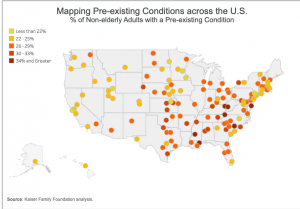
What’s puzzling is the Republicans who want to blow up those protections have no plan to deal with the consequences. The end of all or some of the ACA will have huge effects on families, and there’s NO plan to help families when this happens.
What does this mean for you?
Check the list up top.
More on potential implications here.
A detailed discussion of the lawsuit and where things stand is here.
In which I publicly fess up to miscalls and things I actually got right.
Each year I make predictions about what the work comp world will do in the coming dozen months. Here’s how that went in 2019… (spoiler alert..the ball was a bit cloudy last January…)

1. The work comp insurance market will harden – a little.
Nope. The seemingly endless soft market continues – and there’s nothing on the horizon to indicate it’s going to end.
2. A very big external event/issue/mess will affect the economy – and thus workers’ comp
Nope. Despite more launches by “Rocket Man”, a bunch of trade wars, tariffs that continue to crush agriculture, increasing catastrophes due to global warming, softening economies in Asia and Europe, and an impeachment, the economy continues on autopilot. Sure, one could argue that these and other crises would be a huge story in any other year, but the sheer size and number of daily crises has killed our ability to consider anything short of a collision with the moon as newsworthy.
3. There will be significantly fewer M&A deals in work comp services – and those deals will be either pretty small or really big
Yes.
The Sedgwick/York deal and the OneCall creditor takeover were the big ones. Not much else of size or significance happened…
4. Facility costs will be the new focus for payers and service companies
This is a push; it’s starting to happen – but not fast enough. Every other payer is fighting back, but far too many work comp insurers and TPAs aren’t paying attention.

5. New business models for Pharmacy Benefit Management will gain traction
Yes – transparent pricing is gaining traction, driven in part by the Ohio BWC/Optum litigation and what we’ve learned from it.
6. The “advocacy” claims model will gain a lot more traction,
Among the self-insured employers I’ve been talking with, the answer is yes. While different names are used, there’s definitely a push to get away from the “you’re a claimant” approach and move to a “how can we help”? ethos.
7. “Opt-Out” will not gain traction.
True that.
8. Service companies that deliver best-in-class customer service – and build that into their branding messaging – will win.
Yes. MedRisk has won the PT wars by delivering stellar service (btw the people in the office pictures on their site are real actual humans who work at MedRisk), PBM service leader myMatrixx is landing new customers (EMC, Koch, Qual-Lynx), HomeCare Connect is as well (Zenith Insurance, Great American, Broadspire, Chubb, State of North Carolina). (MedRisk and myMatrixx are HSA consulting clients)
9. More success in reducing long-term opioid usage by more payers.
Yes – but lots more progress is needed.
10. Payers will implement business models and processes using Artificial Intelligence
Yes – Ohio BWC’s work on using AI to code incoming work comp claims looks to be an impressive success. The Hartford is using AI to identify claims for intervention, and legal departments are using AI to scan documents for key words to support discovery and legal issues.
So, 7 right, 2 wrong, 1 a push. To be fair, the two I got wrong are big ones.
Coming up, predictions for 2020.
The House of Representatives just passed landmark legislation intended to reduce the cost of drugs for seniors.
The bill won’t go anywhere, because the Senate won’t consider it – and if it does, President Trump has said he will veto it (despite campaign promises to reduce drug costs).
Unfortunately, a bill advanced by Republican Senator Chuck Grassley that would cap Medicare drug price increases will be opposed by Senate Majority Leader McConnell (R).

Given the public’s focus on healthcare, and seniors’ voting power and high level of interest in drug prices, the lack of GOP support is puzzling. It appears the main objection is reducing what you pay for drugs may result in the development of 8-15 fewer drugs. Over the next decade.
If the House bill became law, Medicare would save $345 billion over six years.
So, seniors would pay less for drugs, taxpayers would save hundreds of billions of dollars, and we may not get one new drug per year.
Only in a government ruled by pharma lobbying would this make sense.
What does this mean for you?
Once again, big business wins, and you lose.

Joe Paduda is the principal of Health Strategy Associates

A national consulting firm specializing in managed care for workers’ compensation, group health and auto, and health care cost containment. We serve insurers, employers and health care providers.